
Exposed Aggregate Concrete in Madison, AL
Madison Superior Concrete installs exposed aggregate concrete in Madison, AL, with the exposure depth controlled by retarder and wash timing rather than left to chance.
Exposed aggregate strips the cement paste off the top of a slab to reveal the stone underneath. It grips when wet, hides dirt and stains, and ages better than a smooth troweled surface.
We do standard exposure using the aggregate already in the mix, or we seed decorative river rock, basalt, and quartz blends into the surface for a specific color range. Free quote either way.

Surface Retarder · Next-Day Wash · Seeded River Rock · Basalt & Quartz · Light to Heavy Exposure · Sealed
Exposed Aggregate Methods
Exposed aggregate means removing the cement paste from the top of the slab so the stone underneath shows. There are three ways to get there and they do not produce the same result.
Surface retarder is the method we use most. A chemical is sprayed on right after finishing, it delays the set of the top layer only, and the next day we pressure wash the paste off to a controlled depth. It gives the most consistent exposure across a large slab.
Washing and brushing is the older approach, done the same day with a hose and a stiff broom once the slab has set enough to hold the stone. It works, but the window is short and the exposure varies more. Abrasive blasting is the third route, used mostly on existing slabs or where a very light exposure is wanted.
- Surface retarder with next-day wash
- Same-day wash and brush exposure
- Seeded decorative stone finishes
- Abrasive blast exposure on cured slabs
- Exposed aggregate bands and borders

Aggregate Selection and Color
The stone you end up looking at is the stone in the mix, unless we seed it. Standard local ready-mix around Madison uses a gray limestone that exposes to a clean, mottled gray-and-tan.
If you want a specific color range, we seed decorative aggregate into the surface after screeding. River rock in browns and tans, black basalt, or a quartz blend all get broadcast on top and floated in. Seeding costs more and gives you exact control over the look.
One thing worth knowing: a wet exposed aggregate slab looks completely different from a dry one, and a sealed one looks different again. We will wet a sample down before you commit so you are choosing based on how it will actually look after sealing.

Where Exposed Aggregate Works Best
Traction is the practical argument. An exposed surface grips wet far better than a troweled one, which makes it a strong choice for sloped driveways, pool surrounds, and steps.
It also hides dirt and staining better than any other concrete finish. On a driveway where a truck drips oil or a walk under a tree that drops berries, the varied texture and color break up marks that would stand out on a smooth gray slab.
What it is not great for is bare feet on the roughest exposures, or for anywhere you need to roll heavy carts. Match the exposure depth to the use. A light exposure gives you the look with a much smoother walking surface.
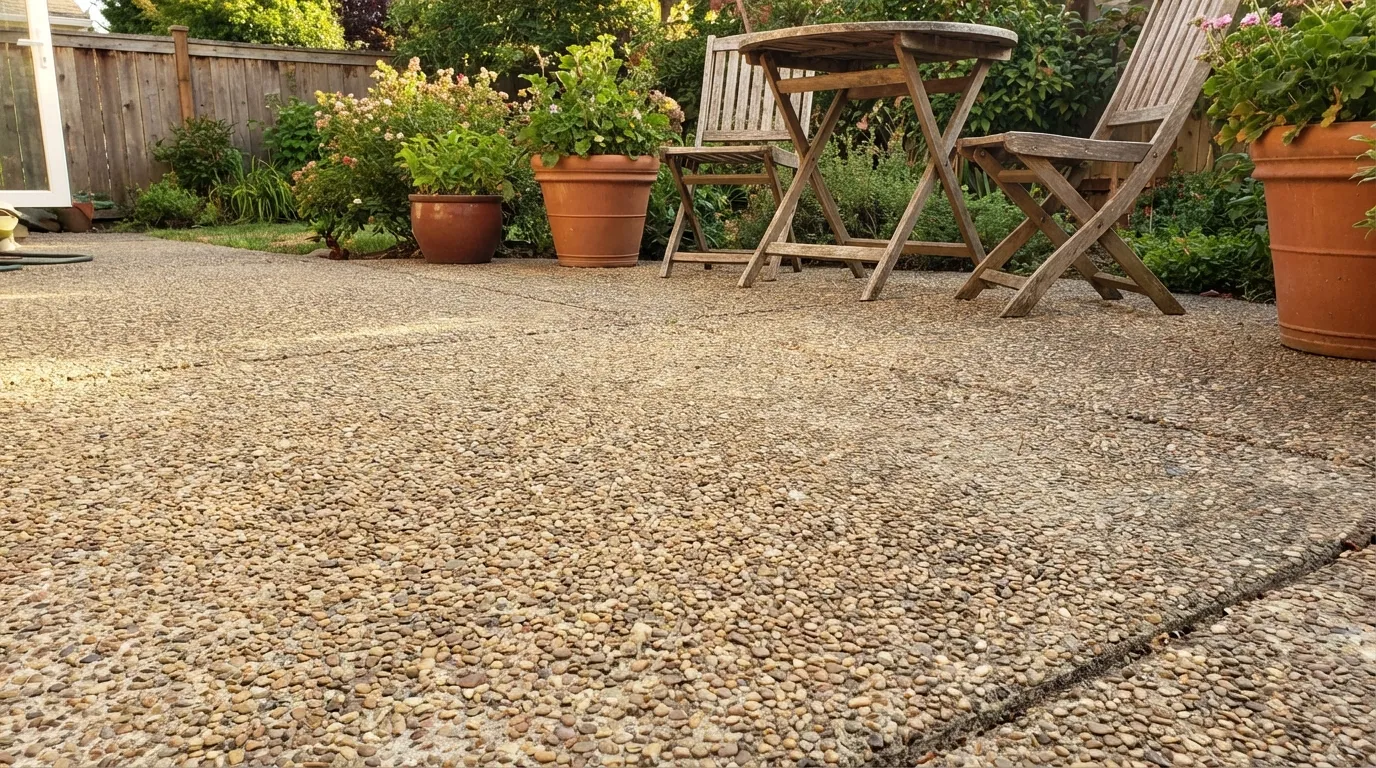
Exposure Depth and Where It Suits
Exposure depth is a decision, not an accident. We set it with the retarder strength and the wash timing.
| Exposure Level | Best Application |
|---|---|
| Light, stone just showing | Patios and pool decks used barefoot |
| Medium, stone half proud | Front walks and general flatwork |
| Heavy, stone fully proud | Sloped driveways needing maximum grip |
| Seeded river rock | Feature areas where color matters most |
| Aggregate band on broom field | Cost-conscious borders and accents |
Exposed Aggregate Installation Process
This finish is a two-visit job. The pour happens one day and the exposure happens the next.
-
1. Aggregate Selection
You choose between standard mix aggregate and seeded decorative stone from wetted samples. We do not let anyone pick from a dry sample, because the sealed result looks nothing like a dry chunk of rock.
-
2. Base, Forms, and Pour
Same subgrade standard as any slab. Compacted base, forms set to the right fall, reinforcement per the application, then the pour placed and screeded flat.
-
3. Seeding or Retarder Application
If we are seeding, decorative stone is broadcast evenly and floated just below the surface. Otherwise, surface retarder is sprayed at a consistent rate as soon as finishing is complete.
-
4. Next-Day Wash
We return the following morning and pressure wash the surface paste away to the exposure depth you selected. Timing matters here. Too early and stone comes loose, too late and the retarder loses its window.
-
5. Acid Rinse, Cure, and Seal
A dilute acid rinse removes any remaining haze, the slab is neutralized and rinsed clean, then sealed once dry. Sealer is what brings the stone color up and keeps it there.
Why Exposure Depth Matters
The difference between a good exposed aggregate slab and a bad one is entirely in the timing of the wash.
One Consistent Exposure
We wash the whole slab in one session at one pressure. Coming back in patches is how you get a driveway with three different textures on it.
Stone Stays Anchored
Exposure goes deep enough to show the stone and no deeper. Wash past the point where the aggregate is still keyed in and you get loose stone popping out for years.
Wetted Samples Before Choosing
Dry aggregate looks pale and flat. We wet a sample so you are picking based on what the sealed slab will actually look like.
Sealed on Schedule
Exposed aggregate without sealer looks dusty within a season. We seal it once the acid rinse has neutralized and give you the reseal interval in writing.
Frequently Asked Questions
Is exposed aggregate more expensive than a broom finish? +
Yes, roughly 30 to 60 percent more depending on whether we are exposing the mix aggregate or seeding decorative stone. The base prep and the concrete cost the same. What you are paying for is the retarder, the return trip to wash, the acid rinse, and the sealer. It usually lands well below stamped concrete.
Is exposed aggregate hard on bare feet? +
A heavy exposure is, which is why we do not put one around a pool. A light exposure feels textured rather than sharp and is comfortable to walk on. We set the exposure depth to the application, so tell us the surface will be used barefoot and we will pull it back accordingly.
Will stones come loose over time? +
Not if the exposure was done right. Each stone needs to stay keyed into the concrete below it, which means removing the paste around it without washing past the point of anchorage. Slabs that shed aggregate were washed too deep or washed too early. It is a workmanship issue, not a characteristic of the finish.
How do I clean and maintain it? +
Rinse it down with a hose and use a stiff broom for anything stuck in the texture. A pressure washer is fine at a moderate setting held back from the surface. Reseal every three to four years, sooner if it is in full sun. Sealed exposed aggregate hides dirt better than any other concrete finish, so it forgives a lot of neglect.
Can you do exposed aggregate on an existing slab? +
Only by abrasive blasting, and only if the slab has enough decent aggregate near the surface to reveal, which many do not. The more reliable route on an existing slab is a bonded overlay with decorative stone seeded into it. We would core or at least grind a test patch first so nobody is guessing about what is under there.
Want Texture Instead of Gray?
Free quote with wetted stone samples before you choose. Pouring in Madison, AL since 1957.