
Concrete Repair and Restoration in Madison, AL
Madison Superior Concrete performs concrete repair and restoration in Madison, AL, with the experience to tell you when a slab is worth saving and when it is not.
Concrete does not fail at random. Cracks, flaking, and sunken panels each have a cause, and repairing the symptom without addressing the cause just buys you a year or two.
We route and seal cracks, patch spalled surfaces, resurface worn flatwork, and lift settled slabs with polyurethane foam. Free assessment, and a straight answer on repair versus replacement.
Crack Sealing · Epoxy Injection · Spall Patching · Resurfacing Overlays · Slab Lifting · Joint Repair
Concrete Crack Repair
Not all cracks mean the same thing. A hairline crack running from a corner is shrinkage and it is cosmetic. A crack you can fit a dime into, with one side sitting higher than the other, is movement and it needs a different answer.
For non-moving cracks we route the crack into a clean V, blow it out, and fill with a polyurea or epoxy that bonds to the concrete rather than sitting in the groove like caulk.
Working cracks, the kind that open and close with temperature, get a flexible sealant designed to stretch instead of a rigid filler that will just crack again beside the original. Choosing the wrong one is why so many patched cracks reappear within a year.
- Routed and sealed shrinkage cracks
- Epoxy injection for structural cracks
- Flexible sealant for working joints
- Control joint cleanout and refill
- Foundation wall crack injection

Spalling and Surface Restoration
Spalling is when the top layer flakes off and leaves the aggregate exposed in patches. It usually traces back to one of three things: finishing while bleed water was still on the surface, deicing salt, or a slab that was never sealed.
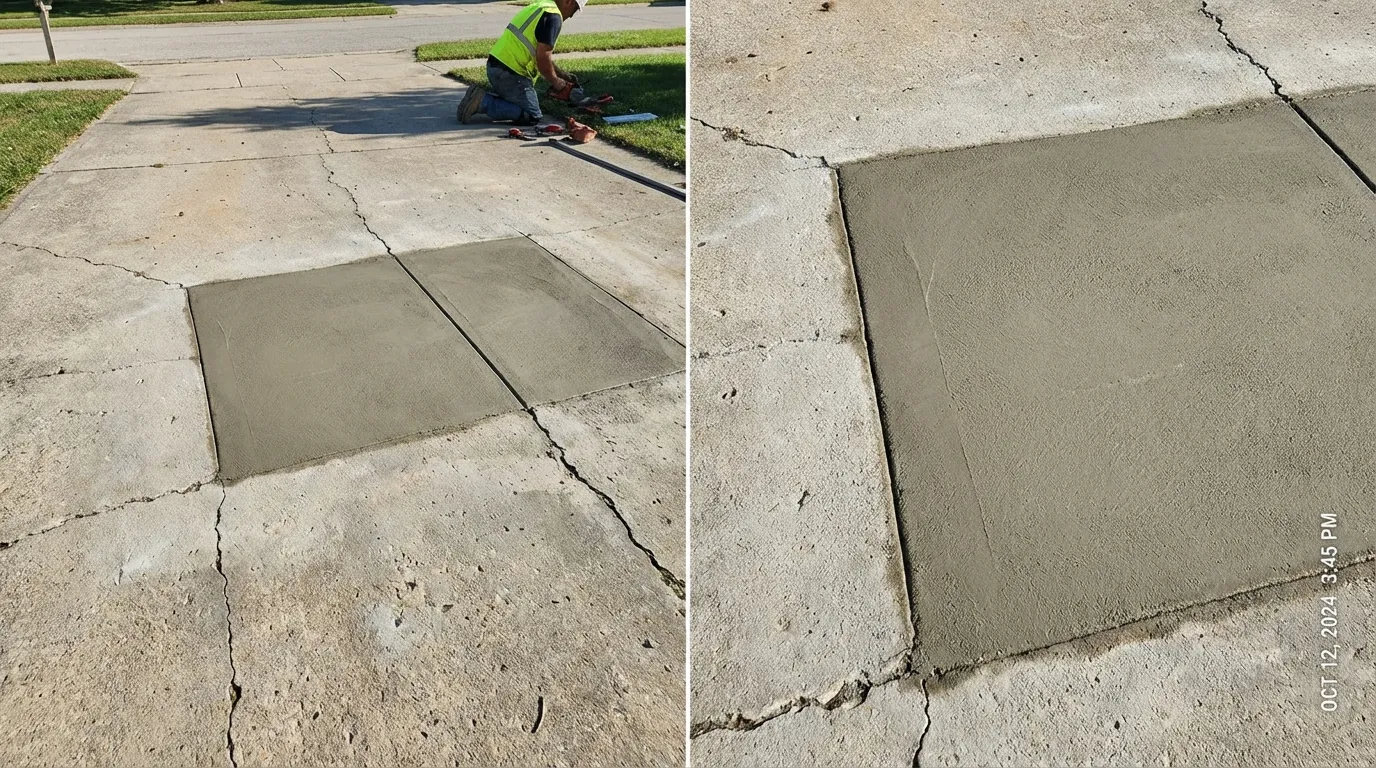
Repair means chipping back to sound concrete, not feathering a thin patch over a soft surface. We saw-cut a clean perimeter, remove the damaged material, prime the substrate with a bonding agent, and place a polymer-modified repair mortar.
Where the whole surface is worn or patched, a full resurfacing overlay is usually the better value. A polymer-modified overlay from a quarter to half an inch thick gives you a new wearing surface that can be broomed, stamped, or troweled. It only works over a structurally sound slab.

Slab Lifting and Settlement Repair
A sunken slab is a void problem, not a concrete problem. Something washed out or compressed underneath and the slab followed it down.
Polyurethane foam injection is how we lift most settled flatwork. Small ports are drilled, expanding structural foam is injected under the slab, and it lifts back to grade while filling the void. The holes get patched and you can drive on it the same day.
Foam works on driveways, walks, patios, garage floors, and pool decks. What it does not fix is the reason the void formed. If a downspout has been discharging under a slab for six years, we pipe that water away first, otherwise you will be lifting it again.

Repair Methods and What They Fix
Half of good repair work is picking the right method. Here is the shorthand we use on site.
| Problem | Repair Method |
|---|---|
| Hairline shrinkage cracks | Route and fill with polyurea |
| Cracks that open and close seasonally | Flexible sealant in a widened joint |
| Flaking, pitted surface | Chip to sound concrete, patch or overlay |
| Sunken or rocking slab panels | Polyurethane foam lifting |
| Panels broken through, base failed | Remove and repour that section |
Concrete Repair Process
Every repair starts with figuring out what caused the damage. Skip that and you are just resetting the clock.
-
1. Cause Assessment
We sound the slab with a hammer to find hollow areas, check crack width and vertical offset, and look at where water is going. Repairing damage without fixing the cause is a service call you will make again.
-
2. Repair or Replace Recommendation
You get an honest number for both where both are viable. When repair costs 60 percent of replacement, we say so and let you decide rather than pushing the smaller job.
-
3. Preparation
Saw-cut clean edges, remove unsound material to a solid substrate, and clean thoroughly. Repair mortar bonded to dust and loose material will delaminate no matter how good the product is.
-
4. Repair Placement
Bonding agent, then the repair material placed and consolidated. We match the surrounding texture as closely as the material allows and tool the edges so the patch does not stand proud.
-
5. Cure, Seal, and Drainage Fix
Patches get cured properly, not left to dry out. Where water caused the problem, we redirect the downspout, add a drain, or regrade before we call it finished.
Why We Tell People Not to Repair
We turn down repair work fairly often. A patch on a slab that is structurally done is money you will not get back.
Honest Repair-or-Replace Math
If the repair is more than about 60 percent of replacement cost, we will say replace. The patched version will not last as long and it will never look right.
We Find the Water First
Most concrete failure in Madison County is water doing something it should not. We trace it before quoting, whether that is a downspout, a bad grade, or an irrigation leak.
Full-Depth, Not Feathered
Feather-edged patches fail. Every repair gets a saw-cut perimeter and full-depth removal to sound concrete, even when it makes the patch bigger.
Color Expectations Set Upfront
A patch will not match perfectly, ever. We tell you that before we start rather than after you look at it.
Frequently Asked Questions
Should I repair or replace my cracked driveway? +
It depends on how much of it is bad and why. Isolated cracks in an otherwise sound slab are worth repairing. Panels that rock underfoot, widespread spalling, or a driveway with cracks running every direction usually means the base failed, and repairs on a failed base do not hold. We will sound the slab and tell you which situation you have.
How long does concrete lifting last? +
The lift itself is permanent as far as the foam goes. Polyurethane does not wash out or break down. What can bring the slab back down is new erosion under it. If we identify and fix the water source that caused the original void, a lifted slab typically stays where we put it indefinitely.
Can you make the repair match the rest of my concrete? +
Close, not invisible. New material cures a different shade than concrete that has weathered for 15 years, and it will stay noticeably lighter for a year or more before it narrows. We match texture well. On a highly visible area, a full resurfacing overlay across the whole slab is what actually gives you a uniform look.
Why is my concrete flaking on the surface? +
That is scaling, and the usual suspects are deicing salt, finishing that trapped bleed water in the surface, or a slab that never got sealed. Salt is the big one here even in mild winters, because the products people spread on steps get tracked around. Once the surface starts flaking it will keep going, so it is worth addressing before it undermines a larger area.
Do you repair foundation cracks? +
We repair non-structural foundation wall cracks by epoxy or polyurethane injection, which seals them against water. If a foundation is actively moving, bowing, or settling, that needs a structural engineer's evaluation before anyone injects anything. We will tell you which one you have and refer you if it is beyond a concrete repair.
Not Sure If It's Worth Fixing?
Free assessment and an honest repair-or-replace number. Family-owned in Madison, AL since 1957.